![[personal profile]](https://www.dreamwidth.org/img/silk/identity/user.png) shrimpchipsss
shrimpchipsssI spent some time recently feeling like all of my friends were going through relationship troubles or relationship bliss and bemoaning the way I love talking about my friends’ relationships but did this really all have to happen all at the same time?
The compounded manic energy of feeling LEFT ALONE and ABANDONED by my coupled up friends of course got me back into thinking about Stephen Sonheim's Company, and about that poem that occasionally makes its rounds on Twitter: After the Threesome, They Both Take You Home by Sue Hyon Bae.
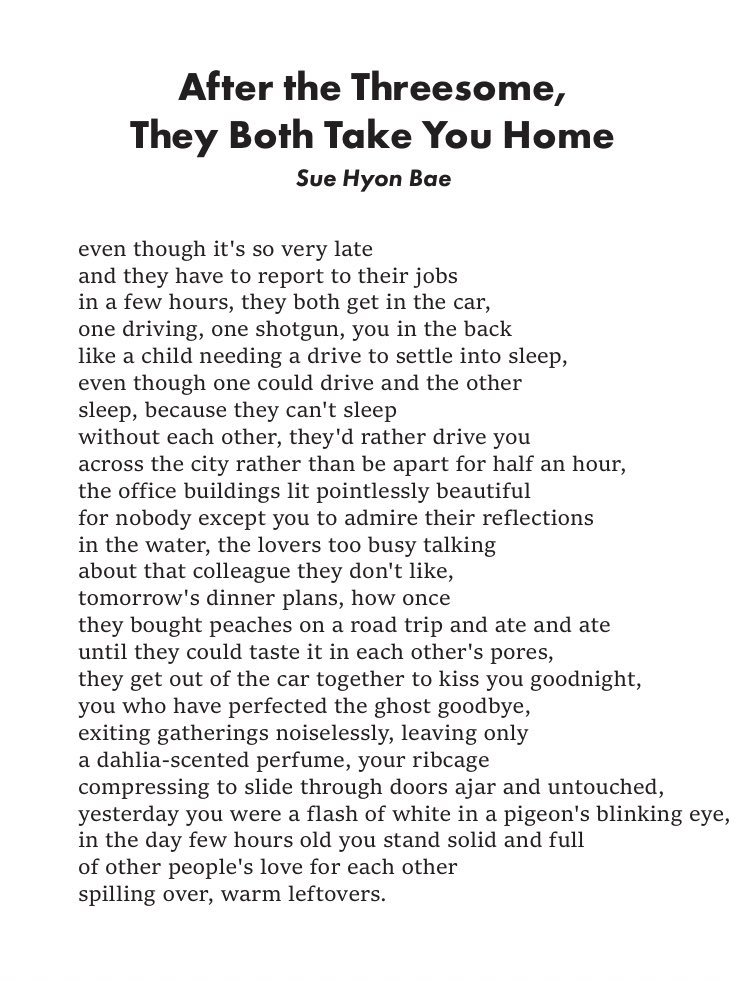
There is something in the way the narrator soaks up the dregs or the overflow (depending on my mood when reading) of the love between the couple they’ve just slept with which made me consider the eroticism between Bobby and his married friends. He’s living his best unattached casually dating life, but of course the real substantive relationships in Company are shown in Bobby’s bonds with his married friends, including the ways Bobby fills in the gaps in his friends’ relationships.
They play a multitude of roles in each others’ lives: Bobby is alternately the child, the sitter, the psychoanalyst (and would you imagine my joy when I realized that the lyric was “you never need an analyst with Bobby around”). Bobby listens to his friends’ relationship woes and gives and asks for advice. The men offer to set him up with women and express their desire to live vicariously through him. The women infantilize him, calling him “poor baby” and wishing for a wife for him and trying to set him up with their friends and relatives while he imagines a lover that is an amalgamation of their traits.
Bobby and his female friends even acknowledge the charged energy between them. He’s “always a flirt but never a threat.” The couples’ married status allows the married friends and Bobby to engage in a kind of harmless, recreational flirting that would of course never threaten the sacred bonds of marriage.
This made me think of a party I was at last year, at which an engaged heterosexual couple I vaguely know started play-fighting in front of the group. This went on for a while with the surrounding group “taking sides” and egging them on and I realized that we’d become voyeurs and participants in their foreplay. And it wasn’t just me who realized. The atmosphere was such that one very sexually open friend in the group, a man, addressing the woman of the couple, said “I am so attracted to you right now.”
Strange, the way heterosexual couples are allowed and even encouraged to flaunt their sexuality in public settings, the way it is admissible for another friend to point out how sexy someone’s partner is because it is understood not as an intrusion upon the relationship. In fact, the comments reify it and prop up the couple’s right and proper attraction to each other.
All this is really just to get to my idea of the heterosexual couple as an erotic unit. The way telling a friend about your relationship woes in a sense brings them into the drama, or the way flirting with someone who is taken (or with both people in a couple at once) isn’t always cheating but is sometimes some secret other thing. Both the poem protagonist and Bobby, though surely having their own individual relationships with the coupled people, are also interacting with [the couple] from whom all blessings flow.
I haven’t read theory in a while so I don’t have much else to add other than I feel like this is the cursed opposite of No Future (queer people should have no children and only jouissance) on one axis and of No Children (heterosexual divorce and suffering is awesome) on another. This is heterosexual reification via jouissance. By a third party. So maybe there’s a third axis in there.
Anyways maybe this is just the delusions of a single person whose brain has decided to eroticize everything in lieu of having a single object of affection but I hope you enjoyed reading it.
Side note: Surely this framework can hold up with queer couples too, and the poem doesn't specify that the couple was heterosexual, but my point is that the VERY PUBLIC and socially accepted nature of this dynamic with heterosexual couples is something that should be studied.
Here is my first Company essay, for those inclined.


